Newer Feature
Meet Julio: The Baby Titi Monkey Winning Hearts One Tiny Hug at a Time
Wild Current's March 27, 2026 feature follows another infant primate whose recovery became a shared act of public tenderness.
Read storyAbandoned at birth and learning how to belong, a baby macaque at a Japanese zoo found comfort in an unlikely companion and touched millions in the process.
Archived Feature
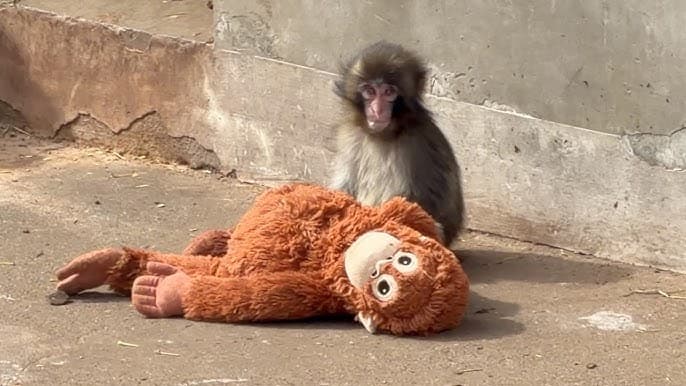
Before Punch became one of those rare animal stories that seemed to halt the internet for a moment, he was a vulnerable infant trying to survive a difficult beginning. Public reporting identified him as a baby Japanese macaque at Ichikawa City Zoo in Japan, born in July 2025 and later hand-raised after his mother abandoned him.
Stories like this often harden into shorthand. The public sees the image, learns the broad outline, and carries away the feeling. But the real texture of Punch's early life was likely more demanding than any single photo could show. Hand-rearing a young macaque is an act of sustained, watchful care, and it comes with a problem that has no simple emotional answer: helping an animal survive while preserving the social instincts that make life with its own kind possible.
As Punch grew, public accounts said zookeepers introduced comfort objects to ease his stress. One of them, a stuffed orangutan, became more than background detail. In the images that spread across the world in mid-February 2026, the toy looked almost like a stand-in for certainty: something to hold, something familiar, something that did not ask Punch to be more settled than he already was.
That detail is part of what made the story stick. The object was ordinary. The need behind it was not. Viewers did not need specialist knowledge to understand why a young animal might cling to softness while navigating confusion, absence, and the effort of adaptation.
"Punch's story felt intimate because it showed a universal instinct in a very specific life: when the world is uncertain, even the smallest creature reaches for comfort."
The reaction to Punch was not only about cuteness, though that would be too easy an explanation anyway. The response carried a deeper recognition: here was a baby animal whose circumstances were both unusual and instantly legible. He had been hand-raised. He had struggled to integrate. He had found a visible point of attachment. And in that sequence, people recognized a story about vulnerability, not performance.
Visitors later reportedly flocked to the zoo as the story spread. That kind of attention can be uneasy territory. Viral compassion can illuminate careful work, but it can also flatten it. What gave Punch's story its staying power was the sense that the emotional image led back to a real behavioral challenge rather than away from it.
For Punch, the harder story may have been the quieter one that followed. Public accounts suggested he later struggled to integrate with the troop, which is precisely the kind of challenge that can remain mostly invisible to distant audiences. The spectacle is easy to share. Belonging is not.
Yet that is what gives the archived feature its weight. Punch was never only a viral image from a Japanese zoo. He was a young macaque moving through the uncertain space between dependence and social life, between individual care and the larger rhythms of a troop. The world responded because the story was tender. It endures because the tenderness pointed toward something real.
Timeline
July 2025
Public reporting later identified Punch as a baby Japanese macaque born in mid-2025.
Early months
After being abandoned by his mother, Punch was cared for directly by zoo staff while they monitored his development.
Winter 2025-26
As Punch grew, caretakers reportedly faced the delicate challenge of helping him adapt to troop life.
Mid-February 2026
Images of Punch holding a stuffed orangutan began circulating widely online and in news coverage.
Related Stories
Newer Feature
Wild Current's March 27, 2026 feature follows another infant primate whose recovery became a shared act of public tenderness.
Read storyEditorial Theme
A closer look at how viral wildlife moments can open a doorway to deeper conservation attention.
Read story